

Before the Bell Rings
Inside the CTL's Summer Agenda
Given that we began the 2025-2026 school year with an exploration of the kinds of work CTL did all day, we thought it appropriate to close with the kind of work we’ll do all summer. For many, the summer months offer a kind of fallow period. The pace and freneticism of school being in session has subsided and it’s undoubtedly an abrupt transition. We lean into the concept of Ecocycle Planning at this point, precisely because it gives credibility to intentionally shifting one’s focus, given the time of year and the needs of the group. And while we’re proud of the work we’ve completed, like a shark swimming in the water, we know we’ll need to keep moving forward in support of faculty, staff, and student learning as we confront the demands of 2026-2027.
As it turns out, our fallow period is pretty full.
The Research We’re Making
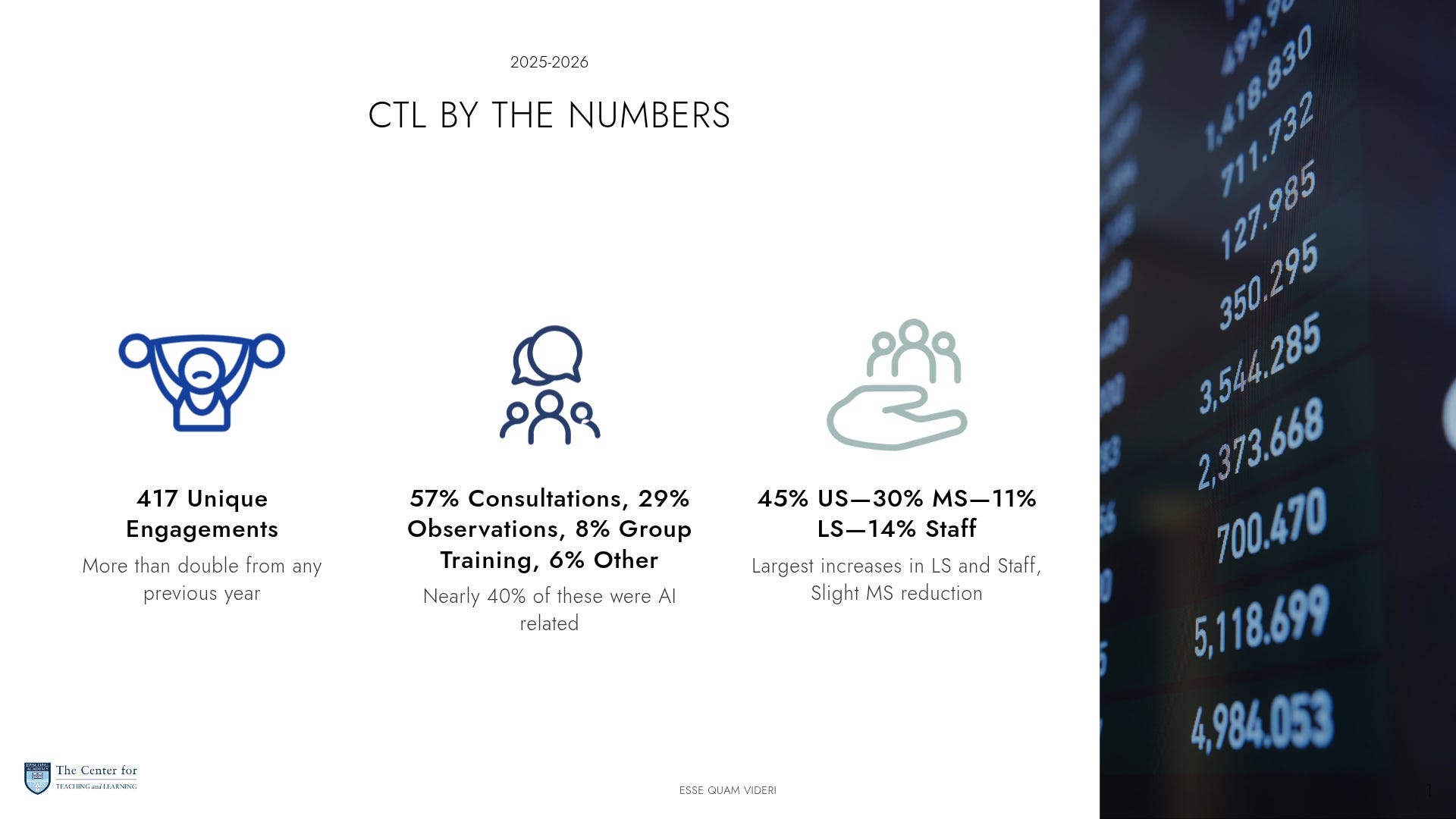
Numbers tell a story, but of course they can only tell part of a story. One number not shown above is $250,000—the amount awarded to EA and the CTL via a November 2025 EE Ford Foundation 'Educational Leadership' grant to hypercharge our work related to the Scholarship of Teaching & Learning (SoTL). We are of course fans of research in education. But so too are we fans of generating classroom insights that improve teaching practices (especially in the age of AI), identifying the kinds of practitioner questions that might seed new strains of inquiry for researchers, or closing the gap between what the research says and what actually happens in classrooms. We are building a network of teacher researchers in the spirit described by Dylan Wiliam below. That work has begun, but we’re pouring gasoline on the fire this June, July, and August.
Courses Built for What’s Actually Happening
This summer we're also partnering with Upper School Chemistry, History, and Computer Science teachers—and their Middle School counterparts in History and English—to co-develop courses where AI becomes a kind of through line, as opposed to an add on. We're not merely sending students into the AI jungle to navigate the chat window of their choosing. Instead, we're investigating tools like PlayLab, ScholarStack, Show Your Learning, and others to consider what teaching and learning might look like in the age of generative artificial intelligence. We're not alone in thinking this way. University of Chicago president Paul Alivisatos captured it well in a recent announcement to students writing, "Instructors at all levels are navigating a fast-evolving landscape, and the University has a duty of care to ensure that the education offered to you is responsive to these technological developments by teaching you how to think with machines, how to think without them, and how to think about them."
A noteworthy part of this co-development includes a partnership with University of Pennsylvania’s Dr. Robert Ghrist, Andrea Mitchell University Professor in Electrical and Systems Engineering and in Mathematics, and Associate Dean for Undergraduate Education in Penn Engineering. Ghrist’s work on AI integration in the classroom has inspired us in CTL for some time, and we’re excited for what’s to come from this collaboration.1
From Mission to Classroom
For the entirety of the 2025-2026 school year, the EA community (teachers, students, staff, alumni, trustees, families) engaged in an intensive process to develop a comprehensive Portrait of a Graduate. With a mission, motto (Esse Quam Videri), The Stripes, and history spanning over two centuries, there was an ample evidence base from which to build. But how might these things show up in our classrooms at a PK-12 school? What sorts of activities, assessments, and experiences lead to the outcomes we espouse in the portrait? These are questions the CTL team is grappling with this summer. And in grappling with them, we hope to create a robust series of professional development experiences to help teachers identify the unique brushstrokes they might offer along a student’s journey at the school.2
Sun, Sand, and the Science of Adolescence
We're taking it bicoastal this summer as well, as members of CTL (along with four middle school faculty) head to the University of Southern California in July to take part in the CANDLE Innovation Lab's Summer Design Sprint. The sprint is designed to bring the science of adolescent learning directly into classroom practice—giving teachers tools to motivate students, strengthen belonging, and deepen learning. We're particularly excited to connect with Dr. Mary Helen Immordino-Yang, whose research on emotion, culture, and the developing brain has shaped a great deal of how we think about what schools are actually for.
Come Learn With Us
Last, but certainly not least: The fifth annual Transforming Teaching Summer Collaborative (TTSC) is coming up on July 15-16th right here at EA, and it might be the best version we've put together yet. TTSC is designed for leaders of teaching and learning curriculum coordinators, department chairs, division heads, CTL directors—who want something more than a conference. The format builds in real planning time alongside inspiration, and this year's featured facilitator Lori Cohen will lead participants through a design sprint focused on envisioning impact and identifying the levers to make it real. If you're the kind of person who leaves most conferences energized but empty-handed, TTSC is built for you.
Note: We’ll be back this Thursday with the first summer edition of ‘Thursday’s Three Things.’
Much, much more to come here this summer.
And by robust we mean 30+ PD sessions, derived from the six pillars of the school’s forthcoming Portrait of a Graduate.